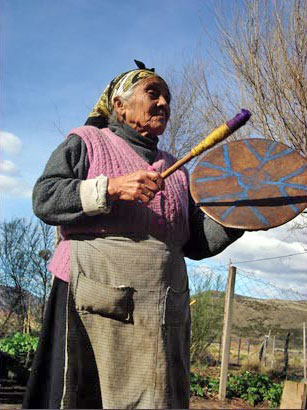
Recently, I attended Nguillatun with Daniela and Stephen, a Mapuche festival where the indigenous group thanks deities and ancestors for a good harvest, and predicts the upcoming year's events.
 We walked up to the ceremony where many families had set up tents and had been camping all weekend, and immediately sensed hostility -- at the very least we felt very unwelcome. I had thought this was a celebration that was open to people, but we had kind of walked into a very sacred ceremony wearing bright colors and walking in the holy circle where the ritual was being performed.
Mapuches are very somber, wearing all black with the only colors being ribbons of various colors tied to a headdress, each one symbolizing a different, very specific thing. Their jewelry is square and heavy with little coins attached to different pieces. Their music is sad because of the cold, harsh climate where they had lived for centuries, and the constant wars first with Spain then with Chile.
The Nguillatun is one of their most sacred holidays and we rolled up in lime green and coral jackets, ready to dance -- a tad inappropriate for the sacred occassion. Few Spanish-looking Santiaguinos were even there, and we were there speaking English wondering what all the fuss was about as we were asked to step out of the holy circle vaguely marked off with canelo branches, sacred branches that are made into medicines by the Mapuches.
There was a lot of jumping in the ceramony, and the local Machi, the shaman, was drumming her kultrun, and eventually went into an hours-long trance where she spoke in tongues about this year's upcoming events.
Once Tio Jorge (the same wonderful tio who lent me his ID to go to the hospital three months ago), showed up it was a different story. He is a popular man wherever he goes, and people were offering us homemade sopaipilla bread from their tents, and we got to sit in on the Machi softly drumming in her trance. Quite a sight. Especially since everyone was crowded around her, speaking in tongues, and "Hurrah!"-ing every time she said something in this language.
Throughout this ceremony the Mapuches would shake branches from the canelo tree, some splashed with water.
A jug of homemade liquor was passed around in an earthenware jug while the Machi was in her trance. First you had to pour some of the liquor on the earth and say a few words, not for relatives or friends who had died (my first thoughts) but to thank the earth for this beverage. Afraid I might go blind or lose feeling on one side of my face or offend someone by not doing it right, I passed.
-- Lauren