Thursday, April 15, 2010

Aneya & Lauren: Spirituality.


Lauren: Another difference between the U.S. and Chile: Spirituality. It is so polar opposite, it's a bit confusing. Aneya and I constantly find ourselves thinking "Should I answer that?" or "It's a bit personal." People can ask questions that in the States are beyond taboo.

Aneya: I discussed this briefly in my Easter post, but I'll say it again. It is a shock to have to answer questions about your religious beliefs five minutes after meeting someone. It's one of those subjects: politics, money, religion. These are things you just don't discuss in every day conversation with complete strangers. And yet. That doesn't seem to be the case here.

Lauren: Your relationship with a higher power (or lack there of) is totally off limits in polite conversation. Here you will frequently find people whose names you can't remember asking, "And what's your relationship with our Lord and Savior Jesus Christ like?" It's very peculiar.

Aneya: It makes me uncomfortable, quite frankly. Because I don't want to lie to people, but I don't want to go into my personal spiritual beliefs with them either. Can't we just talk about the weather?

Lauren: I'm used to religious affiliation/spirituality being deeply personal, between you and whoever you choose to share that information with, and even sharing that can be awkward. I have a litney of friends whose spirituality/personal beliefs is a complete mystery. And that's fine. I feel like that would just polarize us if we started arguing about what "real" spirituality is. It's just too personal to talk about. But here it's totally kosher, even used as an ice breaker.

Aneya: Ya, I don't talk about religion with even my closest friends. That may be because I have a diverse group of friends, from lots of different cultures and spiritual backgrounds, and I'd just be opening a can of worms if I did. Why bother? I guess because everyone here is Christian, there's no problem asking people about it, they already know the answer. But not so in the States. There's a multitude of religions and cultures and everyone takes great care not to offend anyone else. Thus, conversations about religion on the whole are usually avoided.

Lauren: I've even joked about the openness people have here about discussing religion at the most awkward times, saying "Can you believe he just asked me that? How odd." The typical response is, "Is that strange? Does that make you uncomfortable?" Umm...yes. Sharing your spirituality is something that, in the U.S., is a really big deal. Maybe with a long-term partner, your family. Not strangers.

Aneya: Ya, no joking about that stuff, Lauren! They don't like it. The fact that we've both been asked these questions, by perfect strangers, indicates how frequently, and casually, people do it. Religion is everywhere, from the Virgin Mary on the top of Cerro San Cristobal, to huge billboards (like the one pictured above, "God is bigger than your problems") I knew coming in, that Chile was a Christian nation. I just didn't know to what extent. Well, now I do.

-- Aneya & Lauren

Tuesday, April 13, 2010

Lauren: Things I Miss.

In a word: Trader Joe's. I miss their strange quirky food, meatless sausages, nut selection, hummus, cheeses, prepackaged falafels with tabbouleh, weird prepackaged Indian food -- basically everything.

I miss family and friends, but I want them here. I drink a good beer and think "So-and-so would love this" or go to a museum, walk down the streets, check out an antique bazaar and think of family and friends who would love this more than I am loving it. The architecture, events, outdoorsy things, vineyards -- each one has a corresponding person who I want to share these memories with.

But I don't want to go back to Los Angeles for family and friends. I want them to come here so I can share these interesting new things with them.

But I miss LA for the food. Being vegetarian there is, I would say, almost easier than being an omnivore. There is never not a vegetarian option. To only have two or three is even uncommon. There are vegan restaurants and raw places, not serving food cooked above 180 degrees (F).

Here there was recently the vegan animal festival where vegetarian food was sold, but other than that there's only one restaurant that sells high quality, vegetarian food and you can just eat there everyday. The only other place to buy vegetarian food is from the kids on the street, selling veggie burgers. Last time I ate one of those I ended up in the hospital (again) so that's a no go.

Here faux meat smells, tastes, and looks like dog food. To ask for something vegetarian is to say "Just chicken" or "pork." Your meatless dish will come out of the kitchen peppered with pieces of ham, beginning a long "should-I-or-shouldn't-I" conversation with yourself. Things that are normally assumed to be meatless in the states, like yogurt, come with gelatin or other weird animal by product.

It's just hard. I've taken to limiting what dishes I can order, and have been doing a lot of cooking at home. The first few weeks I was just starving, because salads for every meal arn't satisfying, but I am slowly learning to cook with different products, cut certain things out of my diet that now contain animal products (like yogurt).

Hopefully, Trader Joe's will open an international branch on the South American continent, preferably in Santiago. Until then, I'm eating a lot of nut products, and doing a lot of adjusting.

-- Lauren

Sunday, April 11, 2010

Lauren: Working in Constitucion.

The doctor from Mercy Malaysia and me, his speaking partner.
Where we saw patients. I sat in a chair next to this cot, and translated between the Malayisan doctor and the people who came into the clinic.
There are towns of these media aguas. This one Puertas Verdes consisted of 90 families. As the spooky fog indicates, it was absolutely miserably cold and the temperature inside these huts wasn't much different from the outside.
People worked really hard to make their media agua their own, building porches, installing glass windows. It will take at least a year to build enough housing for the internally displaced people living in these camps.
Sunday Mass at Puertas Verdes.

Sometimes things just seem to be fate. I was really looking for jobs here in Santiago, mostly as an English teacher. Then, without having even applied I got a call from the Malaysian Embassy looking for a translator for an International NGO headed south to do some medical earthquake relief work.

A way to contribute to earthquake relief, in my field (I was a poli sci major, too), and with decent pay found me? I had to say yes. I got the call on a Tuesday, met the doctor and nurse team on Thursday, and was in a 4x4 with seven strangers by 8 a.m. Friday.

As with this whole South American experience, I went in with the mentality that if worse came to worse, if things were too much to bare, there's always a way home and quickly noted where the bus station was. I didn't know these people at all and would be living with them for the good part of a month -- a bit scary, but also adventurous and exciting.

We were working in conjunction with the local medical authorities, who sent us to camps of internally displaced people and rural posts they could not get to. There was a clinic downtown Contitucion that had been destroyed, and the clinic in nearby Cerro Alto was now responsible for the health of 40,000 people. Normally they were at capacity with 2,000-3,000, and eager for someone to get out to the camps.

On Saturday we started out at the largest IDP camp: Puertas Verdes. There had been a problem with clean drinking water and tons of people had horrible diarrhea and were vomiting. Clean water is really the difference between life and death. I've known that, but never seen a community of people dangerously suffering from diarrhea first hand.

Our first patient was a young mom with a sweet little girl who just started to projectile vomit in the clinic and I totally lost my cool, bursting into tears. Now, first of all I have never been in a clinical setting except when I myself am visiting a doctor. And to see a young mom, probably my age, with a girl who had diarrhea for about four days was just a lot for me to take. I knew this wasn't going to be a luxury vacation, but it was hard for me to see people so sick from something that should be preventable.

After that and a good talk with our doctor I was in better shape. I was helping people in the camp talk to our team of Mercy Malaysia team. That day I think we visited nearly 50 people.

Every day we'd load the car with medical supplies and set out to either an IDP camp or a rural post that the clinic couldn't attend to. So many people were affected by the earthquake or tsunami. One camp, Los Canas, almost entirely consisted of folks who had their homes on the beach and watched them get swept away, left with almost nothing.

Immediately, when we went to another camp with better water, the range of illnesses was vast. With the cold there were a lot of common cold cases, especially for folks living in tents and media aguas. It was just bone chillingly cold and the inside of those huts were almost no different than the outside.

As always, no one could say my name. It's almost impossible here. In Contitucion I was now Lorinz, which was close enough for me.

As Lorinz, I said things to people that I never before said to another human being. "Please remove your pants so we can take a look at that rash," "Does the pain in your side move to your right testicle?," "May I examine your breasts?" and "You need to lose weight." That last one was actually the most difficult, especially when people get defensive, so I started tossing in "The doctor says ..." before saying "you're too fat".

We worked in at least 10 different places, some a hour's drive from our base clinic, far off onto dirt roads.

One of these rural assignments was doing house calls to bedridden people who had either what's here called a brain attack (thrombosis), late stage dementia, or, like one girl, contracted meningitis as a child. In meeting with these folks, I again realized what a privileged life I lead. Not only did I have clean drinking water, but was able to walk, run, sit, eat, talk, get out of bed without the assistance of another person.

One woman had her adobe house near the river washed away when it swelled from the tsunami. When I told her she was a good daughter for caring for her bedridden mom, she started to cry saying "She's all I have" and I knew she meant it. She really had nothing else. Second and last time I cried. She gave me some mums, which grow like crazy here.

Another case that really affected me was that of a man who complained of something relatively normal for the rural setting, he might have fallen off his horse or injured himself doing wood work (logging was a common occupation there). With him was his daughter, and something just didn't seem right. She was a nervous wreck, but didn't say anything. I was worried there might have been abuse, but later learned that the roof of their house collapsed immediately after the earthquake started, instantly crushing and killing her 10-year-old brother.

Throughout our stay we saw a lot of people with PTSD. Shaking, crying, nervous, unable to eat, sleep, unable to relax. One young girl, maybe 8 years old, was unable to eat after the earthquake and had lost a lot of weight, concerning her big sister who brought her in for a check up.

The entire trip was a real eye opener. Even though we were near the destroyed beach community, it was basically the Taj Mahal compared to how so many people are now living. I was prepared for tent living, and instead was in a cabin, with (usually) hot water, three course dinners prepared by the other members of the team, and a bed.

I was so touched by the kindness people there showed us, despite facing challenges of immeasurable proportion.

Coming home, I realized how much I really have and I am so grateful for everything.

-- Lauren

Lauren: The state of Contitucion.

Quite a few commercial fishing boats washed up on shore after the tsunamis in Contitucion. This was one near the hospital we worked in conjunction with. The "R" on the side indicates that it's been reviewed searching for survivors.
So many homes and businesses were made from adobe -- basically sticks and mud. You could tell that it was a really charming little city, but the buildings were too weak for the combination of an 8.8 earthquake and maybe as many as six 11-meter tsunamis.
The remains of one family's house, just one wall.
This sign reads "We love you the same Contitucion." It's outside an area where people were living in tents, and above the sign the Chilean flag is flown proudly.
Sights like this were common.
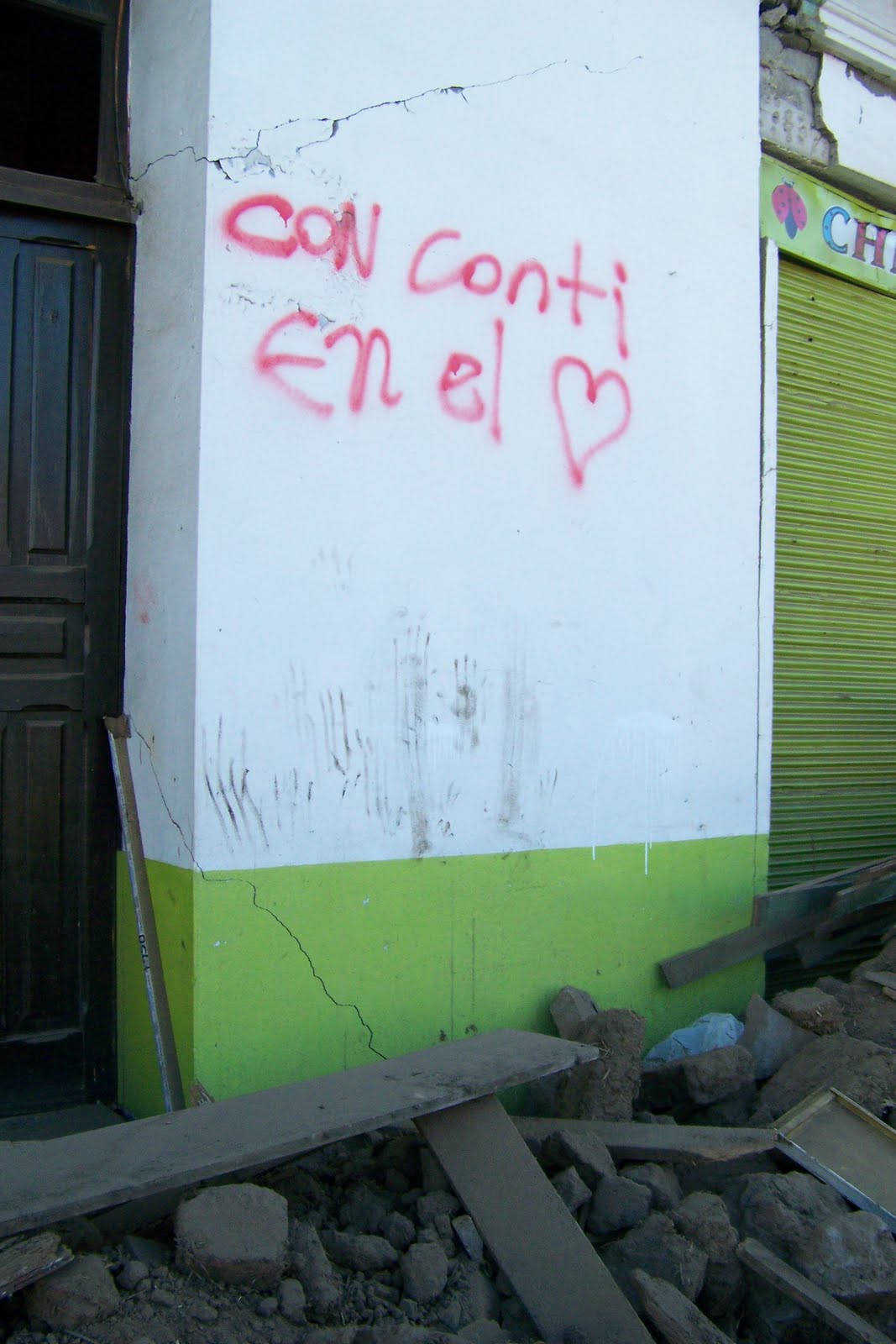
"Conti" is the nickname for Contitucion. This says "With Conti in the heart".


Our director estimated that maybe 80 percent of the town was in ruins.
Every street of downtown looked like this.
You could find the strangest things swept all through the streets in mud, bed posts, aprons, photos, everything you can imagine in a house. This photo is in the black sand that swept into town with the waves.
The cabins where we stayed. The day before I left, this area was being searched for bodies of people who died. There are still between 30-40 disappearances.
This is the beach, just away from our cabins. This was once a thriving beach community with restaurants, hotels, and a discoteque. In the center of this photo is a semi, crumbled like a piece of paper.
So I went to Contitucion for about half a month, briefly leaving Santiago to work as a translator for an international NGO.

Even though so many people were without, struggling, living in tents without clean water, the people of Contitucion were so nice, polite, and calm. As one of the people I was working with remarked, we didn't once hear a Chilean raise their voice.

The south of Chile is known as a very tranquil, relaxed place and this true even in times of catastrophe.

In speaking with people from Contitucion, even though the earthquake and tsunamis happened at 3:30 a.m. they were able to see the waves wash away their town because of the bright full moon that night.

There are trees in Contitucion that are completely brown and dying because they were totally swallowed up into the salt water. There's a popular island where people go to camp, just off shore and everyone camping there was killed when the tsunamis hit. The entire island now is just dying brown trees. Some people say they saw six waves, others say three.

It was so strange to go from business-as-usual Santiago, to a totally devastated city. But even so, they are making every effort to recover.

There are soldiers on the streets, enforcing the law. Prefab schools are being brought in to get kids back into school as soon as possible. That seems to be the most important thing to helping people cope. Getting back into a normal routine.

It was so hard to see "We need water" and "Help please" signs. In speaking with residents, a lot of the aid from NGOs and other donation places was being funneled entirely to the camps for internally displaced people, even though several people were struggling outside of these camps.

Several pipes and drains had burst flooding the streets and many people were without electricity for over a month. Aneya and I were without electricity during the national power outage and it was the most terrifying 40 minutes of our lives.

It was so remarkable and inspiring to see what people can take, and still be so strong and collected. After visit Conti, I am so much more grateful for the things I have. Like electricity, a good, warm place to sleep, and clean water (more on this to come).

-- Lauren


Friday, April 9, 2010

Aneya: Feminism in Chile


Jeez, this is really becoming the Aneya blog, isn't it? No need to fret, Lauren returns tomorrow (yay!) and I will take a little break myself (don't worry, just a small one).

As we've mentioned before, Chile is a very conservative country. And as I'm sure you've noticed I, myself, am not conservative. I'm liberal in probably every sense of the word. My politics, my beliefs, my values. I'd say they're all pretty left leaning. I really didn't think Chile's conservative nature would affect my stay in any way. Well, I was wrong.

I mean, Chile was the last country in the Western Hemisphere to legalize divorce (in 2004!) That's really hard to imagine. That right there tells you just how conservative and Christian the country is. The Constitutional Court outlawed the morning after pill in 2008, the gay community have absolutely no rights here (and are in hiding, quite frankly) and women themselves are devoid of many basic rights, especially in the work force.

Now, how does all this affect me? I've come to realize that it's not just the government that feels this way, every day Chileans also come from a deeply conservative background, and the difference, even in every day situations, continues to surprise me. Take drinking, for instance. Lauren and I talked about our experiences with men here. They all seemed very taken aback by our assertiveness, our attitude, our playful nature.

Oh, and our consumption of alcohol. Someone told me that 3 beers is the limit for women. If a woman drinks any more than that she's considered a trashy girl. 3 beers? Are you kidding me? Who are we drinking with? The Pope? For some, being drunk is a rarity, and something to be ashamed of. So to see a woman drunk is like seeing a unicorn.....is it real? It couldn't be! Oh, but it is. I can't change who I am to become what people here call a "lady". I am a lady. And I drink. And I don't think those two are mutually exclusive. And I don't like being judged for it.

Oh and to think- if only Chileans knew the half of it! Go to any State school in the U.S. and you'll see more drunk girls simultaneously puking and trying to hook up with a guy than you can count. And while that's certainly not "lady like" it's the reality of it. And no one's ashamed of it, no, they're proud. Girls boast about their one night stands, about their binge drinking. People here would truly be appalled. Which is why it's so amusing that people here think Lauren and I are "bad girls". The two of us? Really? If only Chileans knew what really goes on in U.S. universities....

It's apparent that female liberation has yet to hit Chile. They haven't had their post feminist, Sex and the City moment, the moment when women started realizing they can do anything a man can do (and probably better). They can have sex like a man, drink like a man, and work in a corporate setting, earning just as much as a man. That obviously hasn't happened in Chile yet, and I understand why. But let's get moving, people! Please, don't wait until it's too late, and all the amazing, smart females have left, for a country with a higher regard for women.

Thursday, April 8, 2010

Aneya: School kids in Santiago


So schools in Santiago are officially in session (they have been for some time, although everything was postponed a bit after the earthquake) and the school kids are out in full force! Everyone here wears uniforms, which I find so cute. I always wanted to wear a uniform, there's something so posh, so academic, so British about it. I went to a number of different private and public schools and none of them had uniforms. My brother got to wear one for a while, but it's different for guys. Girls fret for hours about what the wear, guys grab whatever's closest on the floor. I don't think it mattered to him one way or another. It would to me though!

The uniforms here come in a few different colors (mostly dark blues, green, grey and black) but they all have the same basics. Girls wear plaid skirts, white shirts (usually with the school logo on it) and these ridiculously huge wool socks, which they roll all the way up to their knees. Need I remind you it's the end of the summer here and still scorching hot in the city, I can't imagine walking around for hours in those! Guys wear slacks, and sometimes even ties, with big thick sweaters and clunky dress shoes.

I see a lot of kids around lunchtime in the park, and I don't know if they're ditching or if they're allowed to leave school for lunch. My little brothers in France used to come home every day for lunch (which was quite a hassle for my mom, driving them a total of 5 times to and from school every day) but they loved it. They even had time to play a quick game of Wii tennis before heading back to the classroom. Oh, what a life.

Anyway, the teenagers here and just like those in any country, really. The girls lay on the grass, laughing and gossiping, the boys playfully push each other around in the metro. Oh- that's another thing. There doesn't seem to be any school buses here. You constantly see kids in the metro, on the bus, walking. They seem like very independent teenagers. They obviously navigate the city just fine by themselves, and they seem to have a lot more freedom than kids in the U.S. do.

I feel like teens here are even more sexually active than those in the States (I know, I know, you don't have to remind me about MTV's "Sixteen and Pregnant") or maybe it's just that they start younger here. The other day I saw a couple going at it against the wall of the metro. When they finally pulled away from each other, I swear to god they both looked about 12. Ahh well. Young love, what are you gonna do? C'est la vie.


Wednesday, April 7, 2010

Aneya: Easter in Chile

The beautiful Iglesia de San Fransisco in Castro, Chiloe

So, we've already mentioned in previous posts that Chile is a highly Christian country. Almost 90% of the population is Christian and most of them are Catholic.

Now, it's one thing for a country to 'say' they are totally Christian when in fact no one goes to church and it's another when the entire country are truly devout believers. I'd say Chile is the latter. I know lots of people who pride themselves on being "good Christians" when they haven't stepped in a church since they were 10 and they think wearing a bejeweled cross around their neck qualifies them to priesthood. It really drives me crazy.

But people here in Chile are old fashioned in the sense that they really are a religious nation. Take this past week, Easter, for instance. In the US there's lots of talk of Easter bunnies and painting eggs and eating chocolate and wearing pretty pastel dresses. Here, it's about going to church, for some it's walking for hours under the scorching sun, to get to the Virgin Mary.

When I was down in Puerto Montt, I noticed groups of people walking on the side of the highway. Now, there was nothing for miles and miles, and yet here they were, some with baby carriages, some with kids of their shoulders, walking down the highway. I asked my friend why they were doing this. He said they were going to pay their respects to the Virgin Mary. I asked why they couldn't just drive to see her. He said it was tradition, for Pascua, to walk. Wow. Now that's devotion!

When we were in Chiloe, I met a bunch of new friends and we all went out to sushi, as I mentioned. Well, one girl starting asking me the usual questions, where was I from, how long had I been in Chile and oh- are you Christian? I was taken aback by the question. No one in the US just flat out asks about your religious affiliations within minutes of meeting you! I answered her honestly and said no, I wasn't. She thought about it for a minute. Then she smiled and said "But you believe in Jesus Christ, our lord and Savior, yes?" Ummm....how are you supposed to answer that? There's only one thing to say: "Yes! Of course I do! Jesus, what a great guy!"

Talk about putting me on the spot! I guess people here just assume that everyone must be Christian so asking the question is sort of like asking, "So you like the Beatles?" There's a 90% chance the answer is yes. If not.....well, you can convince them to like them eventually.

In any case, it's not like the entire country is full of proselytizers, going around asking "Do you know where you're going when you die? Hell!" But still, it's definitely a change from the US. And yet some things remain the same.

At our hotel in Puerto Montt, we came down for breakfast one morning and guess what was on TV? MTV's "Teen Mom" I kid you not. My friend watched the show so much he already knew the couples "Oh, she's so mean to him, just watch". I looked at him in awe. I was shocked. So they get cable and they love all the same crap TV shows we do. But they also go to church consistently and talk about Jesus as if he were their BFF.

Oh, Chile. You continue to surprise me with your contradictory ways. But I still love you.