Showing posts with label chile. Show all posts

Friday, June 11, 2010

Aneya: Lessons Learned from Living in Chile

Adios, Chile! Hola, USA!

Well, ladies and gentlemen, the time has come. I'll be leaving Chile for good on Monday. Yes, it's partly due to the robbery, and the fact I feel less safe now (not to mention I have no readily available money). And it's also just time to move on. It's sad, but true. Lauren and I were planning to leave in a few weeks anyway, I'm just speeding up the process. I've been thinking a lot about the past 6 months I've spent here, and about all that I've experienced, and most importantly, all that I've learned. Here's a few things I've discovered:

1. I'm not as good at languages as I thought: I've always thought of myself as someone who can catch on to a new language fairly quickly, who has a good ear, a fairly good accent. I learned French quickly in France, why wouldn't the same happen in Chile? Because in France I was 13, and here I'm 23. There's a major difference between learning a language as a kid and as an adult. Yes, my Spanish has greatly improved, but I'm definitely not fluent.

2. I need diversity to live. Diversity in all aspects of society. Racially, religiously, socially. Being in a country as homogenous as Chile has made me realize how much I love the States, just for the diversity of its people.

3. Kindness is relative. Lauren told me the other day she never realized how mean people were in LA until she came to Chile. And it's so true. People here (for the most part) are so warm, kind, compassionate, generous and it's heartening to see. It also makes you realize how rude people are in the U.S. (especially in LA).

4. After visiting Buenos Aires for a week, I came back to Chile with a new appreciation for it's public serves. The streets of Buenos Aires were filthy at night, open garbage bags spilling out onto the street. The buses and metros were older, rustier, and there was no such thing as a Bip! card, you had to use coins (and there was a national shortage of those) which was annoying and time consuming. Being in Buenos Aires reminded me of a what a clean, modern and efficient city Santiago is.

5. Just because people tell you it'll be easy to get a job, doesn't mean it's true. That is a lesson I learned the hard way. Everyone I talked to in the States, in the TEFL program I took, told me how easy it would be to find a job. "Just start speaking English and they'll hire you on the spot!" How wrong they were. Never take anything for granted.

6. I can survive an 8.8 earthquake and live to tell about it. This was another hard lesson to learn, since for a few weeks there Lauren and I were both super sad, lonely and scared. But we never once said we wanted to go home. We fought through our sadness, we joined the Red Cross, we helped where we could, and we moved on. I'm proud of us for that.

7. Being unemployed is fun....until it's not. We tried to make the best of our unemployment, and for a while, we did. We made separate trips to the South, we went to Temuco, we did little trips to Valparaiso, to Vina del Mar, we went to Mendoza, we discovered everything that Santiago had to offer. And then, there was nothing else to do. Our money was running out, and it was getting cold. That's when things slowed down, and we both wished more than anything to get a job. But it never happened. And that's when we realized that being unemployed....kinda sucks.

8. I realized that I cannot date anyone who has the following attributes: self righteous, condescending, misogynistic, self pitying, preachy, extremely stubborn (extremely anything, for that matter) small minded, can't think for themselves, easily influenced, and most importantly: I can't date someone who wants to fundamentally change who I am. Not. Gonna. Happen.

9. This one is really for Lauren: Don't talk to strangers! Just because they look normal, or they look like they need help, doesn't mean you need to be "nice" and talk to them. Just ignore them. It may sound mean, but it can help you avoid ugly situations (such as crazy gypsies attacking you). In other words: Trust no one.

10. And last, but not least. Never, I repeat, NEVER put anything valuable in backpack, in a large city, in any kind of public transportation. If you insist on using a backpack, turn it around so it's facing the front of you (you'll risk looking an idiot, but that's fine. I looked like even MORE of an idiot when my bag was stolen). Also, never let your guard down. Not for ONE minute. Not even when you're exhausted and hungry and completely out of it. Stay alert. As Mad-Eye Moody liked to say "Constant Vigilance!"

All in all, these past 6 months have been an emotional roller-coaster, to say the least. I honestly came to Chile with no expectations, I had no real knowledge of the country and its people, no real agenda (apart from getting a job and exploring). I never would have imaged half the things that happened, both good and bad. I met some amazing people, I experienced both beautiful and sad things, and I lived to tell about it all. What I loved most about this trip has been this blog. It's been our baby, and we nurtured and cared for her as best we could. I hope you all enjoyed reading it, because I truly loved writing it.

Thanks for reading, and so long, for now!

-- Aneya

Wednesday, June 9, 2010

Aneya & Lauren: Getting Robbed.

Lauren: It's happens to the best of us. In a big city, it's almost expected. And it finally happened to us. On our way back from Buenos Aires, about two blocks from our own front door my better half on this blog, Ms. Aneya Fernando was the victim of a crime. Amid the commotion on the bus when we were least expecting it someone opened her backpack and took her purse.

Aneya: I don't even really know what to say at this point, I'm still in a state of shock. It was especially surprising given that we've been living in this city for the past 5 months, have used the metros and the buses countless times, have had such faith in the people and now....this. It was also weird because we'd just been to Buenos Aires, a city we both found way more intimidating and scary than Santiago. This city was our home, nothing bad could happen here. Right? Wrong.

Lauren: In retrospect, other passengers on the bus were trying to warn us. They were indicating certain passengers with their eyes, silently indicating that we should be aware of these men, but after an exhausting international flight we weren't picking up on these cues. All we wanted was to be back home and someone saw their opportunity and took it.

Aneya: It's hard because I keep reliving the moment and thinking, what I could I have done differently? Well, obviously I shouldn't have put my purse in my backpack. But I was carrying three different bags and I thought I'd be easier. We were exhausted and hungry and just wanted to get home. Lauren asked a man next to her for directions and suddenly three men surrounded us, each of them telling us different things, distracting us. It made us both really uncomfortable and we just wanted to get off the damn bus. People were shoving and pushing and when I finally jumped off Lauren realized my backpack was open. And my purse was gone.

Lauren: And really, things could have been so much worse. It's a terrible feeling to have someone take something from you, get that close to you, but the robber didn't attack Aneya. We got back to our front door unscathed, albeit a few emotional scars. If we were in Buenos Aires, largely unfamiliar with the city and only knowing Eric it would have been far worse. Instead we came back here, to our apartment rather than a hostel and started putting things together. It's a hassle to get all new things, but not the end of the world.

Aneya: I've traveling quite extensively throughout my life and nothing like this has ever happened, it's really quite shattering, emotionally. Of course the material things I can replace, it just sucks because I had more in there than usual, since we were traveling. First of all, the bag itself was Coach (so was the wallet) and not cheap. In the bag was everything I hold dear.

My passport, my wallet (with various credit cards and my American driver's license among other things) my iPhone, my Chilean cell phone, my iPod, my camera, my sunglasses, the book I'd just bought at the airport, my notebook, my keys to the apartment, basically everything that's important to me. The camera really hurts the most, because I took so many beautiful shots of Buenos Aires and I'm never gonna get those back. So that hurts. I mean, it all hurts. And it's a strange feeling to come home and realize you have basically nothing. No identity. No money. It's like I don't exist at all.

Of course, all these things are getting replaced. I've been wired money, so I'm not broke, I made a new set of keys, I'm looking into getting another cheap, Chilean phone. But it's just not the same. Nothing is. I have to go to the Embassy to get a new passport, which I guess is a good thing, since the pages in mine were almost all filled up.

This whole thing just really makes me lose faith in people, and that makes me sad. It also makes me overly anxious and suspicious now and my general attitude towards Chileans has changed. Maybe it's just a temporary thing. I don't know. All I know is I'm never using that damn backpack again.


-- Aneya & Lauren

Tuesday, May 25, 2010

Aneya: Love Letter to Chile?

Is this the t-shirt I'll be wearing home? (It's kinda cute, so maybe....)

Lauren and I were going through some of our old blog entries the other day (we're almost to 150, can you believe it? Go us!) and we realized that sometimes our blog sounds like one big love letter to Chile. And to be fair, we do love lots of things about this amazing country, and its people. We've talked extensively about their incredibly efficient public transportation system (the regional buses, the metropolitan buses, the metros) about the great free public services the city has to offer (free dance class in the park! piano stairs at the metro!) We've talked about how much we love the kind, caring people of this land. We've talked about how much we love our neighborhood (especially the bars around us). But that's not to say that Chile is perfect. Far from it.

There are some things I can't stand about Santiago: the noise, the smog, the pollution, the endless traffic, the fact that every bus and metro is packed to the limit with sweaty Chileans. The very distinct class barriers (the rich, white Chileans live up near the Andes, the poor ones and the Peruvians live downtown). The jotes (those guys that like to holler), while sometimes amusing, can be downright frightening for a girl walking by herself at night. The strip clubs, although also amusing, can be an eyesore (and right next a church? Really?)

The men here can't seem to take a joke, and they really don't like being called gay. That is the worst possible thing to say to a man here. And of course the gay and lesbian community have absolutely no rights here, even women are treated unequally at times. Like Lauren said, sometimes this place reminds us of America in the 1950s, and although some things are nice (the chivalry) others are not (the constant smoking, the oppression of women).

Another thing I really can't stand is the homogeny here. Not only does everyone look the same, but everyone shares the same religion (Christianity, of course). The conservative nature of Christianity really permeates the culture in a way I've never experienced before. I've never been told how much to drink by a man, or how I'm supposed to behave. I've never been segregated because of my spirituality, never been told I'm not good enough because I don't share the same religious beliefs as someone else. It's a strange thing to experience, and although I've met lots of really nice, easygoing Christians, I've also met a fair share of indignant, self righteous ones that I'd rather not be around.

Every country has their good and bad qualities, not just Chile. I would never say that the U.S. is perfect, it's far from it, in fact. But I still love it, I still call it my home. I have to say though, the good does outweigh the bad here in Chile. This has been such an eye opening experience, I knew it would be different from living in France, but I didn't know just how much Chile would change me. But it has. And I'm happy it did.

-- Aneya

Monday, May 24, 2010

Aneya: Time


Time is a funny thing. In high school, time seemed to drag by at a glacial pace. The fact that my high school in France had the longest school day in the history of the world (8:30 -5:30) didn't help. But everything just seemed so slooooow. When am I gonna leave this wretched place? When do I get to move out, be on my own, be independent, be free? When is this torturous school year finally over? And then, one day, it was. Exams were done, the pool was open, I was ready to spread my proverbial wings and fly. And that I did. All the way to California.

Once I got to La-La Land everything seemed to go by in a blink. I don't know if it's the pacing of university or being surrounded by new friends your very first day. But with a blink of an eye it's already the end of sophomore year, and you can't remember how you got there.

Traveling, of course, screws up your sense of time completely. "What day is it?" "What time is it here?" "What the hell does 19:25 mean?" Trips are never long enough, and you can't believe it's been 2 weeks already and you have to pack it in. This extended journey, on the other hand, didn't have that problem, as we had no return date. Time is a funny thing. Usually, if you're unemployed, you have no rhythm, or schedule to your everyday life. You just kind of float about, and it can make the days seem endless.

These past few months in Chile have gone by so fast, Lauren and I really can't believe it. Especially since we haven't had a steady job this whole time. But we've been on the move constantly (if you recall) traveling and meeting people, experiencing everything we can. It's been an amazing journey, one I wouldn't change for the world, I only wish we had more time. This past month of May has been the slowest, because we haven't been doing much of anything, just hanging around Santiago, trying to save our money (which is no fun at all).

But we realized that we don't want to be in trapped in our apartment, doing nothing for the rest of our time in Chile. We want to be out there, experiencing all this incredibly country has to offer. So next month (which will, sadly, be our last) we're going out with a bang! We're going to cram in as much activity in one month as humanly possible. Because when we leave this place we want to know we did as much as we could, with the resources we had.

Like I said, time is a funny thing. Sometimes I wish she'd just stop, for a moment, and let us all be.

-- Aneya

Tuesday, May 18, 2010

Aneya & Lauren: The Metro.

Aneya: So I obviously didn't take this shot, but it's great! It's at the Universidad Catholica stop, and you can see the flat screen TV, and the beautiful wall art above. Look how high that ceiling is!
Aneya: This is the colorful Bellas Artes metro stop, close to our house.
Aneya: This is too cute. This whole wall in covered in pictures of trees, drawn by kids.
Aneya: Again in Bellas Artes, super clean, and super empty!
Aneya: Lauren and I made the mistake of coming down here one day, not realizing it was an underground mall, not a metro! It's also a walkway to cross the huge Alameda street, above.
Aneya: This is at La Moneda, the financial district (the official government building is also located here).
Aneya: Again, at La Moneda, with it's beautiful wall art.


Aneya: There was an article recently in the New York Times about the brand new metro system that had just been built in New Dehli. It was clean, modern, was built on time and within budget. It was an all out success. But most importantly, it demonstrated a new economic stability and growth in a country controlled by a corrupt government with huge social inequalities. And I couldn't help but think of the impressive metro system here, in Santiago.

Lauren: The metro here is amazing. I am pretty well-versed in public transportation, and these metros are so fantastic, especially compared to the ones in LA. You walk up to a bus or train station and there is always a bus/train headed your way. They're so frequent, clean, and there's really impressive public art. It's fantastic.

Aneya: A well functioning, modern metro system really does say a lot about a city. And Santiago has one of the best underground systems I've ever seen. It's easy to use and understand, you never use coins, always your Bip! Card, which can be recharged at the ticket counter. There are policemen watching at every corner, making sure you're not jumping over the barriers. They're strict here, and the metros are always spotless.

Lauren: They're so nice, that everyone is always on them -- all the time. They're so packed, and not air conditioned, the one thing LA trains have. But they're so frequent there's almost no way you can use the "I'm late because I missed my bus/train" because they are always coming and speeding away. The design of the metro is really impressive. The lines are like the spokes of a wheel with the different lines meeting in Centro. It's a very efficient way to get around.

Aneya: Some metro stops have beautiful wall art (Like at La Moneda and Universidad Catholica, above) and they all have flat screen TVs for people to watch while they wait the 2 minutes until the next car shows up. Usually some 90s pop star is singing old school hits (Mariah Carey, Shania Twain, U2) there's also the occasinal Taylor Swift song. Right after the earthquake, the TVs had seminars on how to relax, decompress, breathe deeply, because everyone was so stressed out.

Lauren: I could not believe those TVs weren't stolen or vandalized! They are so nice. It is so funny to see what they have playing on them. Shania and U2 are big hits on the metro.

Aneya: The place is always packed, of course, and it can get hot and sweaty, when you're jammed up against the door, but it's all good. You get off soon enough. And people always give their seat up to elderly women, or moms traveling with kids. Everyone is very considerate.

Lauren: People are so nice on the metro, and you can always see people giving up their seats. It's so considerate.

Aneya: One thing I've noticed is how huge the metros are here. They were built fairly recently and are therefore extremely modern, some have 4 separate levels, complete with many escalators, elevators and stairs. The ceilings are high, and square, not low and round, like the ones in Europe. Even the metro in New York is a lot lower, and dingier.

Lauren: Daniela actually told me that they bought all their trains used from France and Japan, which explains why they are so nice and modern, and there are different types of metros. Some are blue, and some are red and white. I am so glad we've had such an efficient metro system!

Aneya: In any case, the metro is a real life saver for someone like us, sans car. We like taking the bus too, especially in the summer when it was scorching hot underground. But the metro never fails, it never takes you too far or won't let you get off, like the bus. It's reliable, and I like that.

-- Aneya & Lauren

Monday, May 17, 2010

Aneya & Lauren: Illegal Aliens Abroad.


Aneya: For the first time, Lauren and I are experiencing being a so-called "illegal aliens" in another country. It's a strange thing. As US citizens, we have no idea what it's like for immigrants trying to make it in America. Obviously we've heard stories- how hard it is to do absolutely anything- from renting an apartment to getting a cell phone, everything is a million times harder if you're a foreigner.

Lauren: I've always hated that phrase, "illegal aliens." It sounds like a criminal from another planet has invaded the country. It's such an awful phrase, used only in the most hateful contexts. For the first time Aneya and I are experiencing what it means to be undocumented in another country. It is so hard, and our minor hardship is a fraction of what undocumented people have to go through in the US.

We're not exactly here illegally (our Mendoza trip solved that), but we're foreign without work visas, and we're experiencing how hard it is to get a job, or even a savings card at the grocery store, and be treated differently.

Aneya: And the things we've had to go through here are nothing compared to what illegal immigrants have to go through in the US. Here, we pay for our apartment every month in cash. Can you imagine it? In the US they'd think a drug dealer was living in the apartment. But it's our only choice. We can't get a bank account because we don't have a route number (sort of like a social security number). It's extremely hard to get one of those if you're not a citizen. And you need it for just about everything. But somehow, we've managed just fine.

Lauren: Almost fine. It is truly a miracle we got our apartment, and that's something I am grateful for every day. We haven't been able to get jobs and at every interview we're told we'll get paid less because we are RUT-less. We don't qualify for a bank account, a grocery savings card (which never ceases to amaze me), and we're definitely treated differently.

Aneya: We give the cash to an extremely understanding landlady (also an immigrant- from Spain, as a matter of fact. Which could explain her empathy for us). We got cell phones on our second day here, we didn't need to sign a contract or do much of anything, really. We paid in cash, we got the phone, when the minutes run out, you buy more. It's as simple as that. Try going to an AT&T store in the US, it will take half an hour just to talk to someone. And when you do, you're getting a contract, whether you like it or not.

Lauren: I've always sympathized with friends who've told me how hard it was to be from another country and living in the U.S. but now I can see a fraction of what they have to go through. No diver's licenses, jobs that pay less, and getting harassed. Where Aneya and I are assumed to be rich, and people overcharge or in the very strange case in Vina, refuse to serve us, undocumented people get harassed in a different way.

Aneya: When we got our internet set up, we were supposed to have a route number, but we just used Daniela's. No big deal. Can you imagine? In the US, using someone else's social security number? You'd be put in jail! But not here. It was relatively easy.

Lauren: This entire trip has given me a new perspective on how people living away from home in the States must feel.

Aneya: Strangely, one of the hardest things to get is Lider Savings Card! Of all the things in this country, Lider is the most strict! No route number? No card. No using someone else's, either. It's like they're trying to overcompensate for everything else being so easy.

Lauren: And language. If you are ever lacking for words, people will help you communicate. There's never a This-is-Chile-and-we-speak-Castellano-here-so-get-used-to-it attitude. I really don't see that ethnocentrism at all. I can't imagine living with the hostility that some people in U.S. have toward people who don't speak English. There is no patience or understanding. It doesn't matter if it's your first day in the States, if you're just visiting. If you set your foot down in the U.S. you are expected to speak perfect English.

Aneya: Obviously another thing that's difficult is the job situation. Most jobs want you to have a working visa. In order to get one, you need to have a contract from a job. But if you don't have a job, you don't have a contract. It's a catch 22, really. There are jobs that will hire you even if you're illegal, but they pay less, of course.

Lauren: It's horrible. No job wants to hire someone without a visa, but to obtain a visa you need a job. And why would you be looking for a job if you have one that is sponsoring you? It's inane. We've been to the immigration office, which I am convinced is it's own circle of hell, and were explained this strange system. Nothing however beats the U.S. I can't imagine being stopped in the street and asked to prove my status.

Aneya: In any case, living in a foreign country as an illegal immigrant is definitely a challenge. We've had minor struggles we've had to deal with, but I can't even imagine what immigrants in America must go through every day. And I feel like people here are more understanding, whereas in the US it's all about "those damn foreigns taking our jobs!" The American attitude towards illegal immigrants really needs to change. Everyone's an immigrant! We're a nation of them. I don't know when we stopped being compassionate, and starting being racist, and bigoted and cruel. Just look at Arizona!


-- Aneya & Lauren

Thursday, May 13, 2010

Lauren: Nanas.


In our first few weeks here, we went to the jumbo Jumbo, like a Super Target, and there was an entire isle devoted to smocks for nanas. Granted, we were in the wealthy area of town, but women wearing these checkered gowns can be seen everywhere.

Both maids and nannies, these women walk the dogs, clean the house, take the kids to the park, and do everything. In the summer the nanas in our area would take their lunch break together outside our apartment, each in a green gingham jumper, five seated on a bench chatting among themselves. The smocks nanas usually have to wear are really awful. I hate any job that requires people to wear humiliating uniforms, and the unflattering gingham immediately announces to people your profession, since no one would willfully wear one of those smocks without being a nana.

These jobs are often occupied by Peruvian women. A friend of mine said if you are the cleaner, or the one left with the ironing in the family your family might call you "the Peruvian".

On a recent job interview in a very nice part of town, I saw these women all over walking the dog, carrying the groceries home, pushing strollers.

Below is a clip from a Chilean film that made it to Sundance last year about nanas.

-- Lauren

Tuesday, May 11, 2010

Aneya & Lauren: What We're Reading.

Note: In Cold Blood, by Truman Capote, is noticeable absent from our collection. We recently gave it to Stephen to read (since he was laboring through Infinite Jest, and needed a break).

Aneya: One of the first things Lauren and I bonded over, way back when, was our mutual love of books. Although our tastes vary, we both share a love of reading, and we've been trading books back and forth for years. It all started with our love affair with David Sedaris (who we eventually saw, live at UCLA, which, without a doubt, was one of the best readings I have ever been to in my life. My face literally hurt from laughing so much).

Lauren: That was an amazing reading, and as you can see a copy of Me Talk Pretty One Day is among the books we towed down here and it will definitely make the journey back to the States. Aneya and I both love reading, and we try to trade not just books, but interesting articles we find, and good newsy websites.

Aneya: When we realized we were moving to Chile, we each brought a few books with us, which we quickly went through. We went looking for English bookstore but they were few and far between. Plus, each book cost a fortune! We begged our parents to send us more, and they obliged. Pictured above is the collection we've accumulated so far.

Lauren: ... Minus a few. Books here, paperback English books, cost about $30USD! And Spanish books aren't much cheaper. They're incredibly expensive! And the selection is pitiful, usually "airplane books," some classics, and a lot of Allende (part of the above collection, which I soon discovered I was not a big fan of).

Aneya: We thought I'd be a fun idea to let you all know what we're reading at the moment. We have quite the eclectic collection (as you can tell) and it'll be interesting to go back through books we've already read and recall how we felt about them.

Lauren: Which is pretty much what we do over lunch/dinner anyway. We fill each other in on the news the other missed, and tell each other how we feel about each other's books. It's almost like a tradition now.

We've been doing so much reading since we've gotten down here. Anything in English that we can get our hands on or that our parents generously send us. If it's in English, we read it. And some Spanish. We'll be doing these weekly posts on what books, magazines, news clips we're reading and if you see something we should see, please send it our way via comments.

Aneya: All this is to say that you can look forward to weekly book reviews, every Wednesday, starting next week!

-- Aneya & Lauren

Monday, May 10, 2010

Aneya & Lauren: Mexicanish?

Aneya: Finally! An authentic Mexican restaurant! Here I am, standing in front of the colorful entrance to La Mordida.
Aneya: Lauren, with our take out, and her new friend.
Aneya: This place had the most amazing wall art, I had to get a few shots of it.
Aneya: As you can see, the chairs are painted bright lime green!
Aneya: This Frida one was my favorite.
Aneya: This one is very, Dia de los Muertos. This place was a great find, Lauren!

Lauren: Almost everyone I talked to before leaving California seemed to be under the impression that because Chile and Mexico shared the same language (which isn't exactly true), they had the same culture. I often heard that I would be eating tons of beans, rice, and spicy salsa.

Aneya: Not gonna lie, I was one of the those people. I, like many Americans, was under the impression that anything South of border was just like Mexico. I had never been to South America, never experienced different Latin cultures, I had no idea what to expect.

Lauren: Don't get me wrong. I love Mexican culture, food, and people -- obviously. But I didn't want to move to a country whose culture was something I was already familiar with. Both Chilean Castillano and Mexican Spanish are terrible, but in their own ways. That's about where their tentative similarities end. I've been eating a lot of squash, avocado, and bread. The only tortillas I have are made from potato and spinach (which are amazingly tasty). There is some spicy pebre, but that's actually pretty rare.

Aneya: Upon arriving in Santiago, we both quickly discovered this place is nothing like Mexico. (I'll admit it-- I was relieved! Mexico, as you know, is going through a rough patch right now, and I really didn't want to be involved in any drug lord/kidnapping situations). All of the staples of Mexican culture- brightly painted walls, Mariachi bands, sombreros, tequila, even- were strangely absent here. Not to mention the food! Getting Mexican food here is expensive and hard to find (way more difficult than, say, Chinese food, which they have plenty of).

Lauren: Both are very Catholic countries, but where gay rights are totally nonexistent here, Mexico in the midst of an insane drug war, has legalized gay marriage.

I was kind of missing Mexican culture, especially the Spanish because that's what I speak and understand. It's mas lento, tranquilo. This Castillano stuff can honestly be exhausting.

Aneya: I got my first taste of Mexican culture in Southern California (of course). The abundance of Mexican restaurants, not to mention Mexicans themselves, was shocking to me, since I'd never really been exposed to their culture before. Now, of course, I love a good fajita, quesadilla, taco, or burrito but I don't have the same attachment to the food that Lauren has. What I miss most are tortilla chips- they are so hard to find here! That, and spicy salsa. Spicy anything, come to think of it.

Lauren: I've really started to miss Mexican cuisine in ways that I really never expected. I didn't think I had an especially strong attachment to especially Trader Joe's soy chorizo for my Saturday chilaquiles (I am a master chilaquile maker, if I do say so myself), and there are absolutely no corn tortillas here!

I was super in the mood for Mexican food, so on Cinco de Mayo I made the trek to HiperLider, in hopes of finding some good Mexican food. Still no corn tortillas, and a pitiful canned salsa (no salsa pato to be had). We celebrated Cinco de Mayo in Daniela and Stephen's new apartment with Thea the dog, listening to El Bronx. Still I missed Mexican food. Not gourmet Mexican, but cheap Mexican. Above is the place we found called La Mordida, the bite. It was actually making me a little homesick. This place was amazing and sated my cravings for Mexican food. At least for now.

Aneya: Ahh Cinco de Mayo. Or, as Americans like to call it, annual let's get drunk day! Ask any college freshman what we're celebrating on the 5th of May, they probably have no idea. Something to do with Mexico, and drinking an absurd amount of margaritas. Our Cinco de Mayo was quite tame, compared to previous years. Obviously no one observes the day down here, so Lauren went out and got supplies (even HiperLider had a pitiful amount of Mexican food, apparently) and we went over to Stephen and Daniela's to hang out.

Lauren eventually found out about a Mexican place called "La Mordida" and we went to dinner there one night. The place was colorful and fun, had great food, and they even had an all girl Mariachi band performing for us. It felt like home.


-- Aneya & Lauren

Saturday, May 8, 2010

Lauren: Metro Piano.

Coming back from a recent cultural event Daniela, Stephen, and I discovered this giant piano installed at a Metro Quinta Normal, near where a lot of the city's museums are. It was installed to encourage people to use the stairs rather than take the elevator. There's also a mini library at this metro stop, which continues to fascinate me.

When we went we had to compete with nearly 10 under-seven year olds to run the scales on the giant piano.

Below is a clip from La Tercera. I love how the guy in the video is dressed quite like a piano, with a black and white stripped jacket and white pants.

-- Lauren

Photo credit: Daniela Gutierrez-Fuentes

Thursday, May 6, 2010

Aneya: Old People Party


The other day I was invited to the birthday party of someone in the over 40 crowd. I was curious, what would this party be like? Would it be subdued, people sitting around eating, maybe a glass of wine, some light conversation? I had no idea. But I was about to find out.

My friend who invited me informed me that "it was a boring party, just a bunch of old people" but that we would go, make an appearance, and we could leave if it was no fun. I obliged. But now I was nervous. Was I gonna be introduced to bunch of skeptical relatives? Was I going to have to make conversation....in Spanish? Oh Dios no! I was getting nervous now. We had a previous engagement, to see a friend in a band perform, so we were there until maybe 12:30 when we decided to leave. I was exhausted already, and now this? Crashing an old relative's party at 1 am? This couldn't be good....

We got to the house and the music was blaring, we could hear it from down the street! Cars lined the sidewalk, and we knocked but no one heard us it was so loud. It was a small house, filled to the brim with people, most of them over 50 and dancing their socks off! The impromptu dance party was in the living room, outside was the barbecue and in the kitchen a 10 year old was making cocktails for the crowd. I couldn't believe it. Everyone was super friendly and nice, giving me a besos on the cheek and asking about me (my friend told me "you're like their new toy!")

At one point a man came out with a carving board with cut up meat on it, asking me to take one. With what? My bare hands? I did, not knowing where to put it. There was no plates, no silverware, nothing. Just the meat in your hand. That's a Chilean bbq for you! Take the meat, pop it in your mouth, and you're done with it!

After a few piscomangos I was ready to dance, and we joined the crowd, shaking it to salsa beats, old school American classics and the occasional. reggaeton song. I was having so much fun, I couldn't get over how laid back and relaxed everyone was. They were all smoking, most people were on their 5th piscocola and yet- they were going strong, creating a samba line at one point and getting low for the "Twist and Shout".

Even the 10 year old was still in the middle of the dance floor, by the time we left, at 3 am. I later heard that the party went on until 10 the next day. Oh and it had started at 9 pm. You do the math. It was honestly the most fun I've had at a party since I've been here. And most of the people there were twice my age, maybe more! In any case, I will never again question whether Chileans know how to have a good time. At any age, these people know how to party.


Wednesday, May 5, 2010

Aneya & Lauren: La Cueca.

Aneya: So many people! This is the dance floor at the cueca festival, but you really can't tell who's dancing and who's standing around watching. You can spot some of the men in the ponchos and flat hats.
Aneya: For those who found the dancefloor too constricting- there's always outside! People were cueca-ing anywhere they could! These two were especially cute.
Aneya: The band was incredibly loud, but the people seemed to love every song they played.
Aneya: Daniela got her own cueca handkerchief! She's ready to dance!
Aneya: Not a very good shot, but this is an example of one of the many beautiful dresses the women had on. Check out the guy next to her in the hat!
Aneya: Oh my god, these kids were too cute! Check out how intensely he's looking at her!

Lauren: There's this dance here that is considered Chile's national dance called the cueca. It's a traditional dance from the countryside where people wave handkerchiefs in the air and circle each other, replicating the mating dance between a rooster and a hen. Everyone is taught how to cueca in grade school.

Aneya: We saw Daniela's amazing Aunt and Uncle perform the cueca on tango night. It's such a fun dance, the couple eyeing each other seductively as they circle each other, the women waving their white handkerchiefs, the men stomping their feet with pride. It's a dance with attitude, and I like that.

Lauren: We recently went to this bicentennial cueca marathon in a park far away, we had to take the train, but when we got there everyone, everyone, everyone was cueca-ing. The goal was to get to 1,000 cuecas and I thought surely they would not be able to reach that goal. But by the time we got there they had already done 820-something. The other 180 seemed pretty obtainable by that time.

Aneya: The cueca festival was crazy! So many people walking through the park, where artisinal stands had been set up, selling everything from popcorn and chocolate to jewerly, woodwork,jams, books, toys, posters and of course, the traditional white handkerchief. It was a a Sunday and lots of kids and families were making their way through the crowds, eager to see the dancers perform.

Lauren: The songs are short, only lasting about 1-2 minutes each. Usually men wear traditional flat waso hats with a poncho and cowboy boots. Women wear these really fancy dresses with some kind of ruffly something underneath, and the dance usually starts with the "exhibition" where dancers show the audience their partner. When the singing stops, you lock arms with your dance partner to show that you've "chosen" them. Below is a cueca, courtesy of YouTube.

Aneya: I love love love the outfits! I want to wear those dresses everyday! The women all looked beautiful, even the little girls were all dolled up for the occasion, their skirts enormous, their hair in elegant updos. The men were in ponchos and those funny flat hats. It was a sight to see. Afterwards we walked over to the food tent, which consisted of hunks of meat on a stick (enormous hunks, I couldn't even finish all of mine) and a terremoto- a dangerous drink of pineapple ice cream and leftover wine called pipeno. After one of those, I almost started an impromptu cueca dance myself!

-- Aneya & Lauren


Tuesday, May 4, 2010

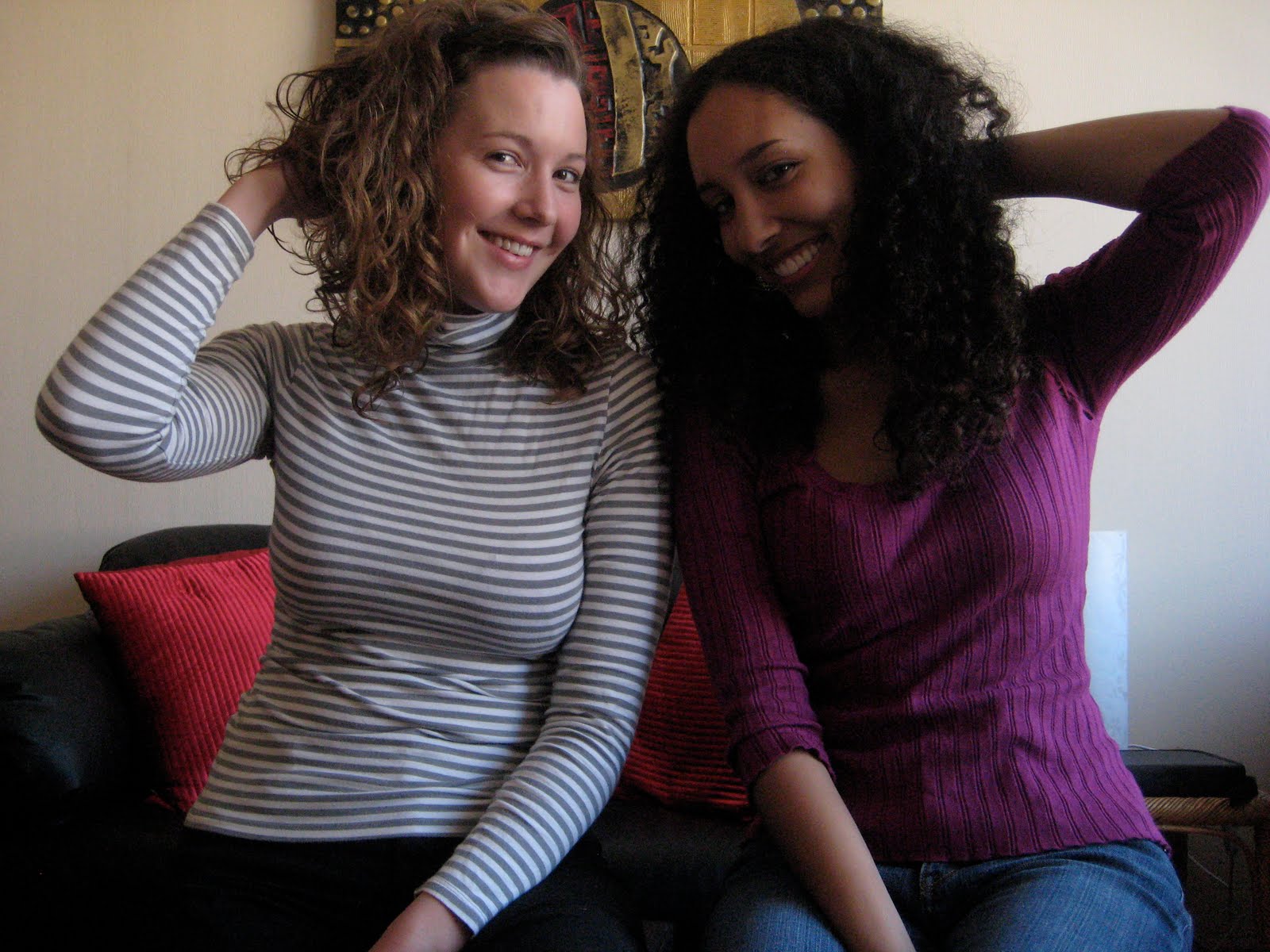
Aneya & Lauren: Curly Hair in Chile.

Lauren and I, showing off our fabulous curls.

Aneya: Having naturally curly hair is both a burden and a blessing. It's a handful to work with, it gets knotty and tangly within minutes, you can't run your hands through it, and you can only brush it when it's wet. It's also something many women envy, and pay good money to obtain.

Lauren: That's the truth. It can really be a pain. If someone tries to touch or brush it, it is just painful, but curly hair can just add a lot to someone's face. I feel like my crazy, knotty hair is an extension of my personality if that makes sense. I just don't look like myself without my frizzy head of hair. Aneya and I are among the group of women who have curly hair and embrace it.

Aneya: Then there's the other women. The ones that shun their curls, and spend hours painstakingly straightening their hair every morning. This is such a common thing in the States, you'll hear many women say "Oh, I have naturally curly hair, but it looks horrible that way." Well that's kind of an insult to those who wear their curls loud and proud. But that's the States for you. Whatever's in, is what's important. Right now, for instance, Hollywood is going through the "Miley Cyrus" wave, which is so fake looking it kills me.

Lauren: I know more about straighteners than I do about any other product just because I've had so many friends who have straightened or wanted to straighten my hair. There's the ceramic-plated ones, which are said not to burn your hair as much, the "gold"-plated ones. Women in the States will spend hours (and loads of money) trying to take the kink out of their hair.

Aneya: Here in Chile, Lauren and I have already noted the lack of vanity. Yes, there are women who wear lots of makeup and do crazy things with their hair. But the majority of women go au naturale, and the same goes with their hair. I've seen more dark curly hair here than anywhere in the U.S. And it's really quite pleasing to see. You'll see long, natural waves, short, tight curls, a mixture of both. The comforting thing is that you know it's all natural, and they are embracing what God gave them. I like that.

Lauren: There something about curly hair that forms a kinship between people, at least women for sure. It was something that Aneya and I instantly bonded over when we first met (Oh, the Daily Forty-Niner). You know that the person goes through some grueling morning routine, that no man will ever be able her touch her hair without her wincing or grimacing, and that she still would rather embrace what God gave her rather than create an artificial look.

Here in Chile there are so many women with curly hair, and I love it. For me it means 1.) I will be able to go to a hairdresser that knows how to "work with" curly hair and 2.) there are a litany of curly-hair products. Both those things are so hard to come by in the U.S. If you have curly hair and go to get your hair cut, the hairdresser always wants to straighten it or cut it for a straight look because that's what's popular.

Aneya: People here are just more relaxed about everything, including their hair, it's almost a relief, really. Coming from L.A., where everyone looks perfect and put together all the time, you feel pressure to look a certain way too. There were times when I wished my hair was more "normal" or easier to maintain. But then I think about the women, especially black women, who spend thousands of dollars and countless hours getting weaves put in just to have hair like mine. And that's when I realize how lucky I am. Cause it's all natural, baby. No chemicals, no weaves, no fake, curling iron ringlets. Just what's on my head. And that's good enough for me.

Lauren: There's definitely no pressure from anyone to change how your hair is here. So many women embrace their curl it actually feels liberating.

-- Aneya & Lauren

Monday, May 3, 2010

Aneya: Seasons in the Southern Hemisphere

Let's hope our apartment never looks like this.

Obviously Lauren and I knew that, moving to Chile, we'd be in the Southern Hemisphere, and the seasons would be reversed. I've been to Australia multiple times, so I've experienced this firsthand. The craziest weather in Sydney was on Christmas day. It was so hot, we spent it at the beach! On New Year's Eve I was in a tiny little dress, walking along the Sydney Harbour with thousands of others in bikinis and shorts. It was surreal. Now, I never actually lived in Australia, and as I've come to realize living in a new country is a completely different experience that visiting.

We got to Chile at the end of January, on possibly the hottest day of the year. It was scorching, Lauren and I were sweating profusely under our layers of clothing, coming from rainy, cold L.A. That in-itself was a shock. The heat was humid, like in New York, and our hostel had no air-conditioning and was unbelievably loud. We were officially in hell. Of course, things got better. We moved into our lovely apartment, the weather (sort of) cooled down. And yet. For months, it remained so hot that taking a leisurely stroll resulted in a need for shade and a glass of water. I was kind of liking it though. Lauren and I are both Southern California girls, and we love sunshine. The nights started getting cooler and then suddenly, one day, everything changed.

I understood that we were supposed to be getting into "fall". The leaves were falling from the trees, the colors were changing. And it yet, the weather seemed to go from extremely hot to downright freezing. Suddenly, we were closing our windows, pulling out the blankets, trying desperately to get our heaters to work. The change was so drastic, and so sudden, neither of us were prepared. I'd brought with me probably 10 dresses and 4 sweaters, (what can I say? I like to be prepared for any occasion) and I was getting sick of wearing the same thing every day. So we both had to go shopping, for winter wear (a welcome activity, for me anyway).

Lauren and I are both cry babies when it comes to the cold. You'll see us now, curled up in a blanket, cup of tea and book in hand, not wanting to move an inch, savoring the warmth. And it's not even that cold! Actually, we can't tell how cold it is, because everything is in Celsius, and therefore sounds even worse than it is. "It's gonna be 9 degrees tomorrow!" Lauren informs me. "9?! What does that mean?!" (It in fact means around 48 degrees Fahrenheit, not that bad. But still cold!).

Our apartment seems to be way colder than outside, for some reason. We're both quite worried, because apparently this is nothing. It's gonna get colder. Way colder. And we are so not prepared. Lauren especially has been freaking out, saying things such as "I can't live like this!" and "I'm gonna die!" I keep telling her, "We have to adapt! It will all be fine, we'll get used to it." Here's hoping we survive the winter, and that we do indeed, get used to it. Because I get the feeling we'll go into hibernation otherwise.

Thursday, April 29, 2010

Aneya & Lauren: Our 'Hood.

Lauren: So Aneya and I decided to take a walk, get some warm clothes, and take pictures of cute, interesting places that are only a few blocks away from our apartment to give people more of a sense of where it is we're living. Here's what we got.

Aneya: We really do live in one of the nicest areas of town, we're near the center, near Bellas Artes, near Lasstaria, near Cerro San Cristobal, Castilla Hidalgo (where this fountain is located and were we attended the now-infamous castle party). Although at night some areas can be sketchy (particularly around Plaza De Armas and Peru-town) but usually I feel pretty safe, even at night.

Lauren: The fountain at the foot of the hill where the castle is, around three blocks from our apartment. Not really sure who the statues are of or what they're doing. The palm trees remind me of California.
Lauren: Little cafes like this are very close by, some have themes, and are decorated with books.

Aneya: This street is super cute, with little cafes, and it's nestled right in the heart of the city. Juxtaposed with that is those crazy standing only cafes Lauren was talking about, and the hustle and bustle of downtown, mere feet away.


Lauren: The pie/cake store. These pictures are a small sample of how many pies are in this place. There's also a very cute sky blue/white mural on the wall of this place of a cafe with people eating pie, but I didn't want to take a picture of the people eating there; they already seemed a bit sketched out that I was taking a picture of the pie cafe.
Aneya: They do love their cakes here. And pies! I was frankly surprised at how good the pastries are here, as well as the bread. Still, nothing compares to the pastries of France. Mmmm delicioux!
Lauren: These fruit vendors are on almost every corner selling cheap, fresh produce. I got us a bunch of bananas once for like $.40. Although sometimes the produce varies, you can always spot these strange purple and green melons that are shaped kind of like a heart.
Aneya: Of course Lauren would take a picture of a bookstore! Unfortunately, finding books en ingles is really hard, not to mention expensive! But still, who doesn't love a cute bookstore? Lauren and I will peruse through, pretending to read while really only looking at the pictures. We've discovered we are illiterate and neither of us can understand people on the phone. Oh, Spanish, why you gotta be so hard?

-- Aneya & Lauren

Wednesday, April 28, 2010

Aneya & Lauren: Tutoring.


Lauren: So, since Aneya and I have had trouble finding consistent employment, we've chosen to take matters into our own hands: We're starting our own tutoring lessons.

Aneya: Basically, we're becoming entrepreneurs and starting our own business. Because you know what? We can't wait around forever for someone to hire us! We've been here three months, and I taught one class! Lauren has taught none! We've had enough.

Lauren: It started a few months ago, when I put in a call to our new friend Carl, who is from the states, telling him of my inability to find a job. A few months later, he found two friends of his that wanted private English classes, and I met up with them in the Plaza de Armas. I had no teaching background, so Aneya seemed like the perfect partner. We're starting our classes today.

Aneya: I am honestly so happy to have steady employment now. Not that I didn't enjoy all the traveling and sight seeing we've had the privilege of doing the past few months. That was all great. We've met so many amazing people, had incredible, life changing experiences. But then again, the downtime was getting to be a bit much. There's only so much internet surfing you can do. And, I completed a special course, got certified and came down here specifically to teach!

Lauren: Before we left, everyone said we'd step off the plane speaking English and be hired on the spot, right there on the tarmac. This however was not how things played out. We've been searching in earnest for employment for months, albeit doing some traveling as well. Now we're on the road to our own business! We've got the whiteboard, flashcards, and the first two lesson plans, and, courtesy of Andy Franks, a fancy flyer to spread around the streets of Santiago.

Aneya: I know! Everyone was like, "Oh, just say hello and they'll hire you!" That was not the case. To be fair, a major earthquake did hit in the height of hiring season, and for weeks afterwards the entire country was on hold. But we really did try! (Mom, I'm talking to you! We did!) But nothing was sticking. And now we're all set to go! Andy- that poster is amazing, a big shout out to Mr.Franks for making it happen!

Lauren: At first, I didn't come to Santiago thinking I would be teaching English, but in speaking with people who have learned English and now using my own second language on a daily basis, I can see what doors another language opens for people and I'm excited to help people speak with their relatives, be more marketable at work, and just be able to communicate with more people.

-- Aneya & Lauren

Photo credit: Andy Franks

Monday, April 26, 2010

Aneya: Chile's Juice Obsession

Daniela and I, enjoying a big glass of melon juice with our meal.

I don't know about you guys, but I'm not a big juice person. Maybe a glass of OJ with breakfast, maybe a berry smoothie every now and then (although for me those are a meal in itself) but mostly I just stick to water. Occasionally a Coke, if I'm out and about, maybe some wine or beer with dinner. Nothing too crazy. That is so not the case here in Chile.

People here drink juice with every meal. And I'm not talking about some lame apple juice. I'm talking peach, melon, mango, pineapple, the works! With meals! And not in little sippy cups either, I'm talkin big, milkshake size glasses. It's really very peculiar to me. If you're enjoying a big plate of fettucini alfredo, do you really want to be guzzling down some guava juice with it? It just sounds gross to me. But not to Chileans. They love it.

They look at you like you're crazy if you just order water. If it's not juice it's some type of soda, maybe a Bilz y Pap, maybe a standard Fanta or Sprite. Sometimes Chileans will order three different drinks, for one meal. A friend of mine once ordered a pisco sour, a Kustmann beer, and a big pineapple juice. It's like.....which one doesn't belong? I know! The drink one normally only consumes will lounging on a beach somewhere.

My dad, who is Sri Lankan, is also a big fan of juice, and has been known to order a glass of cranberry while having a fancy steak dinner (of course, it being alcohol-fueled Las Vegas, the waiters always assume he means a vodka cranberry and he has to correct them). This doesn't seem as odd to me. Maybe it's because my dad comes from a small, tropical island in the South Pacific, where there's an abundance of mango trees and other tropical fruit, so drinking exotic juice was part of his childhood. But mango juice in Chile? That's weird to me.

Lauren said that when Daniela moved in with her in Long Beach, she was shocked at the lack of juice in the fridge. (The fridge was, in fact, completely filled with booze.) But still, that was Lauren's first indication of the difference between Chileans and Americans, in terms of beverages, anyway.

Not only does juice with a meal sound heavy to me, they're loaded with calories and aren't the best thing to be drinking 24/7. So I think I'll just stick to water, thank you very much. You can leave the jugos naturales for the Chileans. I know they'll drink them!

- Aneya

Friday, April 16, 2010

Aneya & Lauren: The Park.

Aneya: A beautiful cafe/ library in a park in Santiago
Lauren: Some parks here have gym equipment, complete with aerobic and toning machines.
Aneya: The machines could easily be confused for a children's playground.
Lauren: Aneya and I love the parks here. They have a variety of trees, tons of walking space, fountains, and libraries, cafes, and gyms -- for free. You have to pay for the coffee/tea/pastry you get at the cafe, but there are tons of free libraries peppered throughout the many parks around the city.

Aneya: Lauren and I stumbled across the free gym one day on the way to our free dance class, also in the park. The class had been cancelled (due to the recent earthquake) but we were advised to use the colorful machines located next to the playground. A free gym? Yes, please!

Lauren: The libraries are pretty luxurious, with leather couches and sofas, a large book selection, balconies with tables for your coffee or tea, and you can check out any newspaper from the front desk.

Aneya: The library was so nice, it was unbelievable. We didn't actually know it was a library, we saw people sitting outside and figured it was a cafe. And it is. The first floor has deep leather couches, and people bring their laptops and spend hours there, just like at a Barnes and Noble or Starbucks in the States. But here, it's a big, open space with a beautiful view of the park which is really nice. And then upstairs is the impressive library.

Lauren: There are also free public gyms across from children's play gyms, so while your kids play you can work out. It's an incredible public service. There are also cheap bike rentals run through the city where you can pay $2 for a month's worth of bike rentals. Just pick one up, and drop it off at any city-run bike stand.

Aneya: Just another impressive, free public service that Santiago has to offer. Gracias!

-- Aneya & Lauren

Thursday, April 15, 2010

Aneya & Lauren: Spirituality.


Lauren: Another difference between the U.S. and Chile: Spirituality. It is so polar opposite, it's a bit confusing. Aneya and I constantly find ourselves thinking "Should I answer that?" or "It's a bit personal." People can ask questions that in the States are beyond taboo.

Aneya: I discussed this briefly in my Easter post, but I'll say it again. It is a shock to have to answer questions about your religious beliefs five minutes after meeting someone. It's one of those subjects: politics, money, religion. These are things you just don't discuss in every day conversation with complete strangers. And yet. That doesn't seem to be the case here.

Lauren: Your relationship with a higher power (or lack there of) is totally off limits in polite conversation. Here you will frequently find people whose names you can't remember asking, "And what's your relationship with our Lord and Savior Jesus Christ like?" It's very peculiar.

Aneya: It makes me uncomfortable, quite frankly. Because I don't want to lie to people, but I don't want to go into my personal spiritual beliefs with them either. Can't we just talk about the weather?

Lauren: I'm used to religious affiliation/spirituality being deeply personal, between you and whoever you choose to share that information with, and even sharing that can be awkward. I have a litney of friends whose spirituality/personal beliefs is a complete mystery. And that's fine. I feel like that would just polarize us if we started arguing about what "real" spirituality is. It's just too personal to talk about. But here it's totally kosher, even used as an ice breaker.

Aneya: Ya, I don't talk about religion with even my closest friends. That may be because I have a diverse group of friends, from lots of different cultures and spiritual backgrounds, and I'd just be opening a can of worms if I did. Why bother? I guess because everyone here is Christian, there's no problem asking people about it, they already know the answer. But not so in the States. There's a multitude of religions and cultures and everyone takes great care not to offend anyone else. Thus, conversations about religion on the whole are usually avoided.

Lauren: I've even joked about the openness people have here about discussing religion at the most awkward times, saying "Can you believe he just asked me that? How odd." The typical response is, "Is that strange? Does that make you uncomfortable?" Umm...yes. Sharing your spirituality is something that, in the U.S., is a really big deal. Maybe with a long-term partner, your family. Not strangers.

Aneya: Ya, no joking about that stuff, Lauren! They don't like it. The fact that we've both been asked these questions, by perfect strangers, indicates how frequently, and casually, people do it. Religion is everywhere, from the Virgin Mary on the top of Cerro San Cristobal, to huge billboards (like the one pictured above, "God is bigger than your problems") I knew coming in, that Chile was a Christian nation. I just didn't know to what extent. Well, now I do.

-- Aneya & Lauren

Sunday, April 11, 2010

Lauren: Working in Constitucion.

The doctor from Mercy Malaysia and me, his speaking partner.
Where we saw patients. I sat in a chair next to this cot, and translated between the Malayisan doctor and the people who came into the clinic.
There are towns of these media aguas. This one Puertas Verdes consisted of 90 families. As the spooky fog indicates, it was absolutely miserably cold and the temperature inside these huts wasn't much different from the outside.
People worked really hard to make their media agua their own, building porches, installing glass windows. It will take at least a year to build enough housing for the internally displaced people living in these camps.
Sunday Mass at Puertas Verdes.

Sometimes things just seem to be fate. I was really looking for jobs here in Santiago, mostly as an English teacher. Then, without having even applied I got a call from the Malaysian Embassy looking for a translator for an International NGO headed south to do some medical earthquake relief work.

A way to contribute to earthquake relief, in my field (I was a poli sci major, too), and with decent pay found me? I had to say yes. I got the call on a Tuesday, met the doctor and nurse team on Thursday, and was in a 4x4 with seven strangers by 8 a.m. Friday.

As with this whole South American experience, I went in with the mentality that if worse came to worse, if things were too much to bare, there's always a way home and quickly noted where the bus station was. I didn't know these people at all and would be living with them for the good part of a month -- a bit scary, but also adventurous and exciting.

We were working in conjunction with the local medical authorities, who sent us to camps of internally displaced people and rural posts they could not get to. There was a clinic downtown Contitucion that had been destroyed, and the clinic in nearby Cerro Alto was now responsible for the health of 40,000 people. Normally they were at capacity with 2,000-3,000, and eager for someone to get out to the camps.

On Saturday we started out at the largest IDP camp: Puertas Verdes. There had been a problem with clean drinking water and tons of people had horrible diarrhea and were vomiting. Clean water is really the difference between life and death. I've known that, but never seen a community of people dangerously suffering from diarrhea first hand.

Our first patient was a young mom with a sweet little girl who just started to projectile vomit in the clinic and I totally lost my cool, bursting into tears. Now, first of all I have never been in a clinical setting except when I myself am visiting a doctor. And to see a young mom, probably my age, with a girl who had diarrhea for about four days was just a lot for me to take. I knew this wasn't going to be a luxury vacation, but it was hard for me to see people so sick from something that should be preventable.

After that and a good talk with our doctor I was in better shape. I was helping people in the camp talk to our team of Mercy Malaysia team. That day I think we visited nearly 50 people.

Every day we'd load the car with medical supplies and set out to either an IDP camp or a rural post that the clinic couldn't attend to. So many people were affected by the earthquake or tsunami. One camp, Los Canas, almost entirely consisted of folks who had their homes on the beach and watched them get swept away, left with almost nothing.

Immediately, when we went to another camp with better water, the range of illnesses was vast. With the cold there were a lot of common cold cases, especially for folks living in tents and media aguas. It was just bone chillingly cold and the inside of those huts were almost no different than the outside.

As always, no one could say my name. It's almost impossible here. In Contitucion I was now Lorinz, which was close enough for me.

As Lorinz, I said things to people that I never before said to another human being. "Please remove your pants so we can take a look at that rash," "Does the pain in your side move to your right testicle?," "May I examine your breasts?" and "You need to lose weight." That last one was actually the most difficult, especially when people get defensive, so I started tossing in "The doctor says ..." before saying "you're too fat".

We worked in at least 10 different places, some a hour's drive from our base clinic, far off onto dirt roads.

One of these rural assignments was doing house calls to bedridden people who had either what's here called a brain attack (thrombosis), late stage dementia, or, like one girl, contracted meningitis as a child. In meeting with these folks, I again realized what a privileged life I lead. Not only did I have clean drinking water, but was able to walk, run, sit, eat, talk, get out of bed without the assistance of another person.

One woman had her adobe house near the river washed away when it swelled from the tsunami. When I told her she was a good daughter for caring for her bedridden mom, she started to cry saying "She's all I have" and I knew she meant it. She really had nothing else. Second and last time I cried. She gave me some mums, which grow like crazy here.

Another case that really affected me was that of a man who complained of something relatively normal for the rural setting, he might have fallen off his horse or injured himself doing wood work (logging was a common occupation there). With him was his daughter, and something just didn't seem right. She was a nervous wreck, but didn't say anything. I was worried there might have been abuse, but later learned that the roof of their house collapsed immediately after the earthquake started, instantly crushing and killing her 10-year-old brother.

Throughout our stay we saw a lot of people with PTSD. Shaking, crying, nervous, unable to eat, sleep, unable to relax. One young girl, maybe 8 years old, was unable to eat after the earthquake and had lost a lot of weight, concerning her big sister who brought her in for a check up.

The entire trip was a real eye opener. Even though we were near the destroyed beach community, it was basically the Taj Mahal compared to how so many people are now living. I was prepared for tent living, and instead was in a cabin, with (usually) hot water, three course dinners prepared by the other members of the team, and a bed.

I was so touched by the kindness people there showed us, despite facing challenges of immeasurable proportion.

Coming home, I realized how much I really have and I am so grateful for everything.

-- Lauren